Railroad employees face some of the most demanding and hazardous working conditions in the country. Whether working on tracks, operating equipment, performing maintenance, or conducting inspections, railroad workers are exposed to significant risks every day. When a railroad employee suffers an injury on the job, the claim process is very different from a typical workers' compensation claim.
The Federal Employers' Liability Act (FELA) provides a legal avenue for injured railroad workers to seek compensation when their employer's negligence contributed to the accident. Understanding how FELA works can help injured employees protect their rights and make informed decisions after a workplace injury.
What Is FELA?
The Federal Employers' Liability Act, commonly known as FELA, is a federal law enacted in 1908 to protect railroad workers injured while performing their job duties.
Unlike traditional state workers' compensation systems, FELA is based on fault. This means an injured railroad worker must generally demonstrate that the railroad's negligence played some role in causing the injury and/or their employer provide an unsafe work environment.
FELA applies to most interstate railroad carriers and their employees, including:
- Conductors
- Engineers
- Track maintenance workers
- Signal maintainers
- Yard workers
- Mechanical employees
- Railroad inspectors
Because railroad employers operate under federal regulations, FELA claims are governed by federal law rather than state workers' compensation rules.
How Is a FELA Claim Different from Workers' Compensation?
Many injured workers assume all workplace injury claims are handled through workers' compensation. Railroad employees, however, are generally excluded from traditional workers' compensation systems and instead rely on FELA.
Some key differences include:
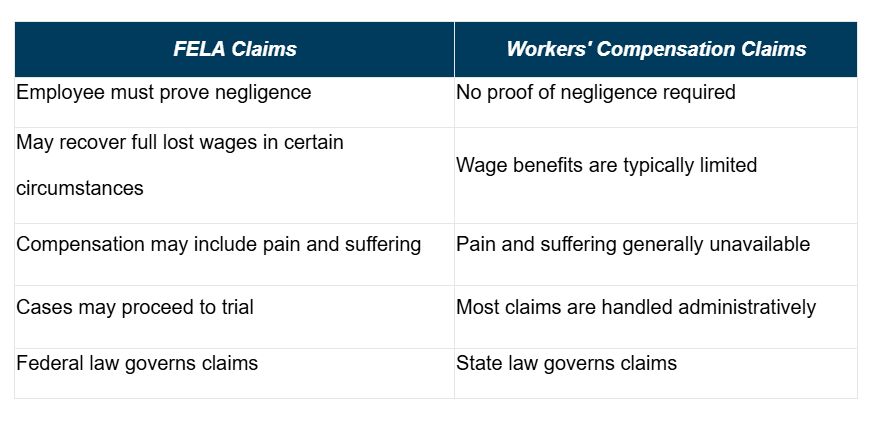
Because FELA allows broader categories of damages, the value of a successful claim may be significantly greater than what would be available through a traditional workers' compensation system.
Common Railroad Accidents That May Lead to FELA Claims
Railroad environments contain numerous hazards that can cause severe injuries.
Common accidents include:
Slip, Trip, and Fall Accidents
Workers may slip and fall on oil, ice, snow, ballast, or uneven surfaces. Poor maintenance and unsafe working conditions can increase the risk of serious injuries.
Equipment Failures
Defective machinery, malfunctioning tools, and poorly maintained railroad equipment can result in catastrophic accidents.
Train Collisions and Derailments
While not everyday occurrences, collisions and derailments can lead to devastating injuries for railroad employees working on trains or in rail yards.
Exposure to Dangerous Substances
Some railroad employees may be exposed to toxic chemicals, diesel exhaust, asbestos, or other hazardous materials that contribute to occupational illnesses.
Repetitive Stress Injuries
FELA also covers certain cumulative trauma injuries caused by repetitive motions, heavy lifting, vibration exposure, or years of physical strain.
What Must Be Proven in a FELA Claim?
To recover compensation under FELA, the injured worker generally must show that the railroad was negligent and that the negligence contributed to the injury.
Examples of negligence may include:
- Failing to provide a safe workplace
- Inadequate training or supervision
- Violating safety regulations
- Failing to inspect or maintain equipment
- Requiring employees to use defective tools
- Allowing dangerous workplace conditions to exist
- Failing to warn workers about known hazards
Importantly, a railroad worker does not need to prove that the employer was entirely responsible. Even if the railroad's negligence played only a partial role in the accident, the worker may still have a valid claim.
What Compensation May Be Available?
A successful FELA claim may provide compensation for losses that extend beyond what is typically available through workers' compensation benefits.
Damages may include:
- Medical expenses
- Future medical treatment costs
- Lost wages
- Loss of future earning capacity
- Physical pain and suffering
- Emotional distress
- Permanent disability or impairment
- Loss of enjoyment of life
In fatal accident cases, surviving family members may also have rights under FELA wrongful death provisions.
What Should Railroad Workers Do After an Injury?
The steps taken immediately after a railroad accident can affect a future claim.
Injured workers should consider:
- Reporting the injury promptly.
- Seeking medical treatment as soon as possible.
- Following all medical recommendations.
- Preserving photographs, records, and witness information.
- Carefully reviewing any incident reports before signing them.
- Speaking with an attorney familiar with FELA claims.
Because railroads often begin investigating accidents immediately, it is important for injured workers to understand their rights early in the process.
How Long Do You Have to File a FELA Claim?
In most cases, FELA claims must be filed within three years of the date of the injury. Certain occupational disease and cumulative trauma cases may involve more complex timing considerations. Missing important deadlines can jeopardize a worker's ability to pursue compensation, making prompt action critical.
Injured While Working for a Railroad? Understand Your Legal Rights
A serious railroad injury can affect your health, your career, and your family's financial security. FELA provides important protections for railroad workers, but pursuing a claim often requires proving negligence and navigating a complex legal process.
The Personal Injury attorneys at Wilentz, Goldman & Spitzer, P.A. help injured individuals understand their legal options after serious accidents and workplace injuries. If you have questions about a railroad injury or potential FELA claim, contact our team to discuss your situation and learn more about your rights.
Tags: FELA • Railroad Worker Injury • Federal Employers' Liability Act